Shop management systems do a lot of things well. They write repair orders, manage inventory, track parts, and process payments. They’re the backbone of daily operations — and every shop needs one.
But there’s a job most SMS systems were never designed to do: manage advisor performance. And when multi-location operators try to use their SMS for that purpose, the gaps show up fast. The data is too old, too high-level, and too disconnected across locations to drive the kind of timely, specific coaching that actually changes behavior.
Understanding why that gap exists — and what it takes to close it — is worth a closer look.
SMS Data Is Built for the Back Office, Not the Counter
SMS reporting is historical by nature. You’re looking at what happened last week, last month, last quarter. By the time you pull that report, the customer is already gone, the opportunity is already missed, and the advisor has already moved on to the next car.
That’s useful for accounting and trend analysis. But it’s not performance management. Performance management requires feedback loops that are tight enough to change behavior while there’s still time to act. If an advisor isn’t presenting maintenance at the counter, you need to know today — not when you run a report next Monday.
Top-Line Numbers Don’t Show You What Moved the Needle
Most SMS systems report top-line metrics: total revenue, total car count, average ticket. Those numbers matter — but they don’t tell you why the numbers are what they are. They don’t show which advisor is converting maintenance recommendations and which one is skipping them. They don’t distinguish between an opportunity that was missed and one that genuinely wasn’t there.
That’s the difference between reporting and performance management. Reporting tells you what happened. Performance management shows you what should have happened, what actually happened, and where the gap is — at the advisor level, in near-real-time.
Related: The District Manager's Guide to KPIs • Why Your POS System Isn't Enough • Enterprise Multi-Unit Analytics
What “Enterprise” Really Means for Multi-Location Groups
A lot of SMS vendors describe their systems as “enterprise” solutions for multi-location groups. But in most cases, what they’re offering is a set of single-tenant databases that have been connected. Each location is its own silo — you set up job categories separately, configure services separately, and build price matrices independently at each store.
The challenge is that when you want to compare Store A to Store B, you’re comparing data that was never structured the same way to begin with. That makes meaningful benchmarking across locations difficult at best.
True enterprise means normalized data. An oil change should report the same whether the advisor used a package or manually entered the part and labor. A fuel system service should show up the same way regardless of which store performed it or how the advisor wrote it up. That’s what SideKick360’s data normalization engine does — it doesn’t depend on consistency of how jobs are written up from store to store or advisor to advisor.
That’s a big deal. Most of the time when operators struggle to compare locations, the problem isn’t a lack of data — it’s that the data was never structured consistently in the first place. SideKick360 takes that variable out of the equation entirely, so stakeholders can stop wrestling with data and focus on what matters: execution.
Measuring Opportunity and Execution
Effective performance management comes down to measuring two things simultaneously:
- Opportunity — What maintenance was due on the vehicles that came through today? What services should have been recommended based on mileage, history, and manufacturer schedules? This is the universe of potential revenue that walked through your door.
- Execution — What actually got presented? What got sold? Where did the advisor recommend the right services, and where did they miss? This is the measurement of how well your process is working.
- The gap between them — This is where coaching happens. Not in getting more cars through the door, but in capturing the work that’s already due on the cars you have.
Most SMS systems don’t track opportunity — only what was written on the ticket. They can’t compare an advisor’s opportunity set to their execution rate because that data doesn’t exist in the system. That’s not a flaw — it’s just not what they were built to do.
How SideKick360 Fills the Gap
SideKick360 was built specifically for this job. It normalizes data across all major SMS systems into a single platform, so every location’s data is structured the same way regardless of which shop management system they run. That means a district manager can open one dashboard and see:
- Which stores are trending up or down this week — not last month
- Which advisors are capturing maintenance opportunities and which are leaving them on the table
- How each location’s execution compares on a normalized, apples-to-apples basis
- Where the biggest revenue gaps are right now — while there’s still time to coach and adjust
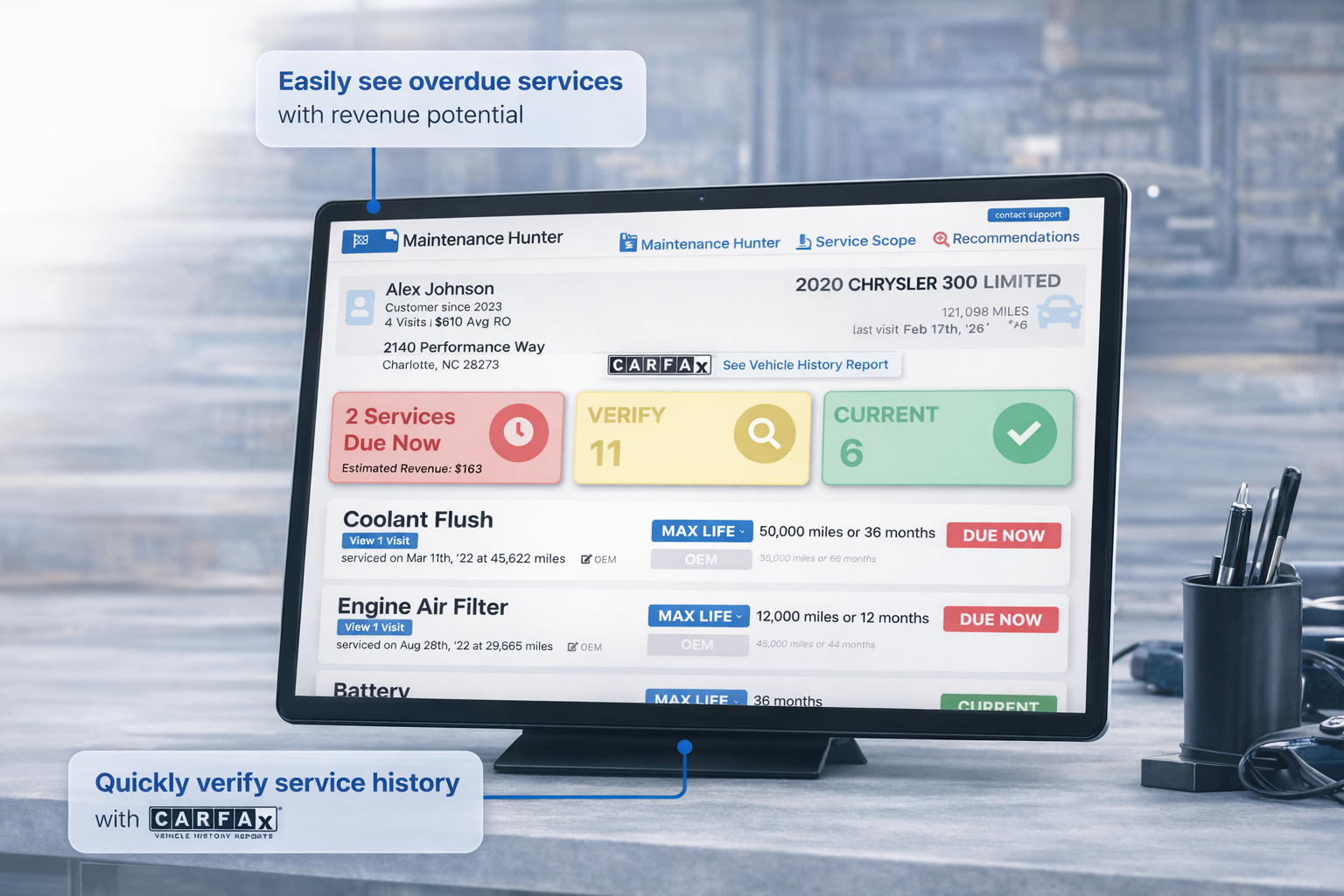
Maintenance Hunter takes it further — scanning every vehicle against service history, mileage intervals, and OE manufacturer recommendations to surface exactly what’s due before the advisor writes the ticket. That’s the opportunity side of the equation. When you pair that with advisor execution data, you have a complete performance management system — not just a reporting system.
And it all happens in near-real-time. A manager can sit down with an advisor between cars and say, “Three of your last five oil change customers had brake flush services due — let’s talk about how you’re presenting maintenance at write-up.” That’s specific, timely feedback that helps people get better at their jobs. That’s managing behavior.
The Bottom Line
Your SMS is good at what it does. Let it handle repair orders, inventory, and payments. But if you’re running multiple locations and your version of performance management is pulling reports from each store and pasting them into Excel — there’s a better way.
Managing a team means advisor-level data, near-real-time visibility, and normalized metrics that let you compare any store to any other store on a level playing field. It means measuring both opportunity and execution — because you can’t coach the gap if you can’t see it. SideKick360 provides everything you need to do exactly that.
If you want to see what it looks like with your shops’ actual data, book a demo and I’ll walk you through it.