Running a profitable auto repair shop is about more than just fixing cars. It’s about capturing every legitimate revenue opportunity that walks through your door.
Most shop owners we talk to are surprised to learn how much money they’re leaving on the table each month. When Meineke Garner Group implemented one process change — leading with maintenance at the time of write-up — their monthly revenue went from $53,600 to $141,500. That’s nearly $88,000 per month that was walking out the door.
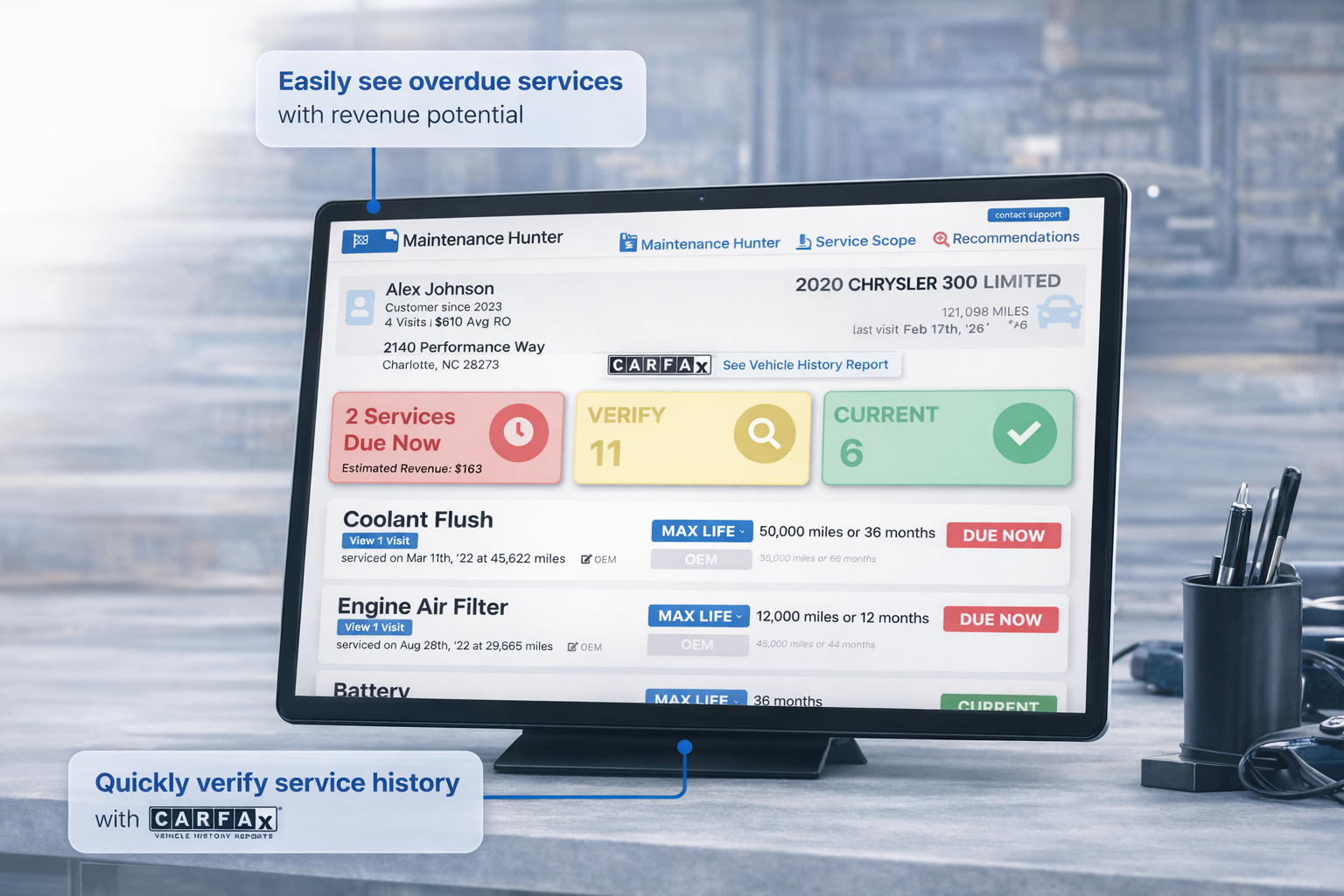
The vehicles hadn’t changed. The customer base hadn’t changed. The only thing that changed was visibility — their advisors started seeing what was due on every vehicle before writing the estimate. Here are five signs that the same gap exists in your shop:
1. Your Advisors Don’t Check Maintenance Until After the Repair
In most shops, maintenance recommendations happen at the end of the process — if they happen at all. The tech finishes the primary repair, maybe notices something else, writes it on the ticket, and the advisor tries to present it at checkout. By that point, the customer has mentally closed the transaction.
When Meineke Garner Group flipped that sequence — checking maintenance before writing the estimate instead of after — their average repair order jumped from $264 to $568. The services were always due. The advisor just wasn’t seeing them at the right moment.
2. Maintenance Recommendations Depend on Who’s Working
If one advisor catches fluid services while another only mentions brakes, you have a consistency problem. Manual interpretation of service histories means every advisor brings a different level of thoroughness, knowledge, and confidence to maintenance recommendations.
The fix isn’t more training — it’s removing the interpretation step entirely. When a system cross-references the vehicle’s complete service history against manufacturer schedules and shows exactly what’s due, every advisor gives the same recommendation every time. At Meineke Garner Group, this consistency drove coolant flush recommendations up 1,967% and brake flush recommendations up 563%. Those services were always due — now every advisor was seeing them.
3. You Can’t Tell Which Services You’re Missing
If someone asked you which maintenance services your shop is underperforming on, could you answer with specific numbers? Most shop owners can’t. Without visibility into maintenance capture rates by service category, you’re flying blind.
Before SideKick360, Meineke Garner Group had no idea they were missing 800% more fuel system services and 229% more transmission fluid services than they were capturing. The data was sitting in their shop management system — nobody was looking at it.
4. Reporting Takes Hours, Not Seconds
If generating a weekly performance report means exporting spreadsheets and doing manual calculations, you’re spending time on admin that should be spent running your business. And worse — by the time you see the numbers, the week is already over.
Real-time visibility into invoices, average repair order, gross profit, and maintenance units means you can course-correct today, not next Monday. You should know how your shop is performing right now — not after an hour of spreadsheet work.
5. You’re Using Your SMS at 50% Capacity
Most shops use their shop management system for writing repair orders and invoicing. That’s maybe half of what the data can tell you. Every repair order your shop has ever written contains service history, customer visit frequency, vehicle maintenance intervals, and spending patterns. That data is sitting in your system right now.
SideKick360 connects to your existing SMS — Mitchell1, NAPA TRACS, Tekmetric, and more — and turns that dormant data into actionable intelligence. No new hardware. No ripping out your current system. It works alongside what you already have.
The Bottom Line
Every one of these signs points to the same underlying problem: your shop’s data has the answers, but nobody is looking at it at the right time.
Meineke Garner Group didn’t add bays, hire more techs, or launch a marketing campaign. They changed when their advisors look at maintenance — and they went from $53,600 to $141,500 per month. The full SideKick360 platform is $200 a month per location, and Maintenance Hunter on its own is $99. There is no investment in your shop with a faster payback.
If you want to see what SideKick360 can surface in your shop’s data, book a 30-minute demo at sidekick360.app. The maintenance revenue is already in your bays. The question is whether you’re capturing it.
Related: It's Not Your SMS — It's Your Process • Why Your POS System Isn't Enough • Book a Free Demo