Ask most shop owners why maintenance matters and you’ll get a version of the same answer: it adds to the ticket. A cabin air filter here, a coolant flush there — nice margin, low bay time, bumps the ARO. All true. And all far too small a way to think about it.
Here’s what I’ve seen over and over in more than 30 years of running stores, districts, and regions: the shops that treat maintenance as a line item get a line-item result. The shops that treat it as the core of how they take care of a customer get something else entirely. Gross profit goes up, sure. But so does retention. So does visit frequency. So do reviews, referrals, and the mood at the counter. It all moves together, because it’s all the same thing.
Maintenance isn’t an upsell. It’s the operating system for a healthy shop. Let me walk through why — and then show you a real shop where every one of these numbers moved in the same quarter.
Start with what the customer actually wants
Nobody wakes up wanting a brake flush. What they want is a car that doesn’t strand them, a shop they don’t have to second-guess, and a bill that doesn’t surprise them. Maintenance is how you deliver all three.
When an advisor tells a customer, “Your coolant is two years past its interval and your cabin filter is due — want us to handle those while the car’s here?” that customer isn’t hearing a pitch. They’re hearing that somebody looked at their vehicle. That somebody is paying attention. That is the entire customer experience in one sentence, and it happens before a single wrench turns.
Compare that to the shop that does the oil change, hands over the keys, and says nothing. That customer got exactly what they asked for and nothing else. They’ll go wherever the next coupon points them, because you gave them no reason not to.
The flywheel: one conversation, five outcomes
Here’s how maintenance actually compounds inside a shop. Each piece feeds the next.
- Gross profit. Filters, fluids, and scheduled services carry better margins than commodity repair parts. When advisors surface what’s due on every car, the parts mix shifts toward maintenance on its own — and GP% climbs without anyone touching a price matrix.
- Revenue and labor hours. Every maintenance item is billed labor on a car that’s already in the bay. You fill the schedule without spending a dollar on marketing or hiring a tech.
- Retention. A customer who’s been shown their vehicle’s full maintenance picture has a reason to come back — the next interval. You’ve turned a repair relationship into a maintenance relationship, and maintenance relationships have a future built in.
- Visit frequency and car count. Customers on a maintenance rhythm come in more often, and they bring the people they know. New-customer growth follows retention more reliably than it follows any ad campaign.
- Satisfaction and trust. Fewer breakdowns. Fewer “why didn’t you tell me?” conversations. The customer feels looked after, and looked-after customers write the reviews you want and stop shopping your price.
Notice that none of those are separate initiatives. You don’t run a retention program and a GP program and a customer-satisfaction program. You run one process at the counter, and the rest follows.
What it looks like in a real shop: Steger Service
Steger Service is an independent shop in St. Louis. They’ve been a SideKick360 customer since 2022 — good operation, steady car count, nothing broken. At the start of 2026 they made one deliberate change: run Maintenance Hunter on every vehicle at write-up, before the estimate is built, and let what’s due drive the conversation. Same team, same building, same location. I wrote up the first quarter earlier this year. Now we have eight months. Here’s January through August, 2026 against 2025.
| What moved | Jan–Aug 2025 → Jan–Aug 2026 |
|---|---|
| Invoices (car count) | +13.3% |
| Total sales | +21.3% |
| Gross profit dollars | +$274,536 (+29.0%) |
| Gross profit margin | 52.9% → 56.3% (+3.4 points) |
| Average repair order | $566 → $606 (+7.1%) |
| Billed labor hours | +20.9% |
| Unique customers | +16.8% |
| New customers | +20.5% |
Read that table as a flywheel, not a list. In the first quarter, car count was up only 3.5% and the whole story was margin. Eight months in, the story has changed: car count is up 13.3%, and it’s being pulled by the customer side of the wheel. Unique customers are up 16.8% and new customers are up 20.5% — both growing faster than invoices. More people are coming back, and more people are walking in for the first time, in the same stretch the shop started talking maintenance on every car.
And the financial side is still outrunning the car count. Gross profit dollars grew more than twice as fast as invoices did, because the margin on every visit got better — 3.4 full points — and there was more legitimate work on every car. Labor hours grew 20.9% on 13.3% more cars. The average ticket went up $40. That’s not a promotion or a price increase. That’s an advisor who knows what’s due before the estimate is written.
Then look at where the growth came from. Cabin air filters more than doubled. Engine air filters up 83%. Coolant flushes up 91%. Fuel system services more than quadrupled. Those aren’t services customers ask for. They’re services somebody looked for. Every one of them is a moment where a customer learned that this shop pays attention to their car — and every one of them is a reason to come back at the next interval.
The part that keeps compounding
What you see in the first quarter is the first turn of the wheel. The bigger effect shows up over the following months, and it’s the one owners underestimate. Steger’s Q1 was a margin story on flat car count. By August it was a growth story on every line.
A customer whose advisor laid out the full maintenance picture in March has a reason to be back in September. When they come back, the advisor already has the history, so the next conversation is easier and more credible. The vehicle is better maintained, so it has fewer surprise failures, so the customer trusts the shop more, so they stop price-shopping and start referring. Each visit makes the next one more likely and more valuable.
Meanwhile, the shop that skips the conversation is running the same treadmill every month: buy new customers, do what they asked, watch them leave, buy more. Their car count might look fine. Their retention is quietly bleeding out, and they’re paying for it in ad spend they don’t connect to the cause.
Why most shops don’t get this result
If maintenance is this powerful, why isn’t every shop doing it? Three reasons I see constantly.
- It’s treated as an upsell at checkout, not a conversation at write-up. By the time the car is done, the customer has mentally spent the money. Lead with maintenance when the keys come across the counter, not when they go back.
- It depends on the advisor remembering. Busy Friday, three phones ringing, and the cabin filter interval isn’t top of mind. If the process lives in someone’s head, it happens when they’re fresh and skips when they’re slammed — which is exactly when you need it most.
- Nobody can see whether it’s happening. Your shop management system tells you what sold. It doesn’t tell you what was due and never got mentioned. If you can’t measure the gap, you can’t coach it.
Every one of those is a process problem, not a people problem. Most advisors want to do a good job. They just need to know what a good job is on this car, right now, before the estimate is built.
Where SideKick360 fits
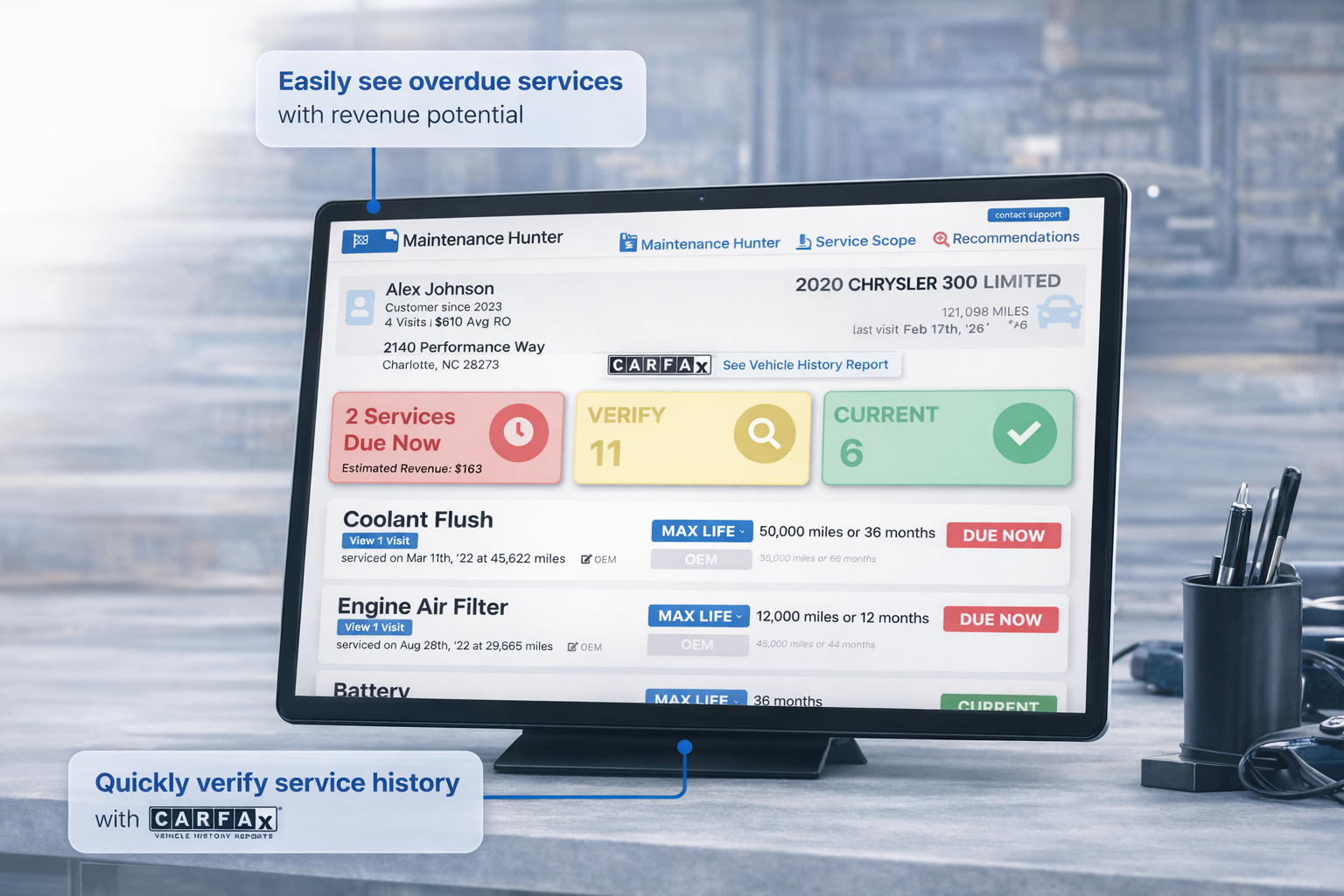
This is exactly what Maintenance Hunter was built for. It reads the repair order data your shop management system already has, checks every vehicle against its maintenance schedule, and puts what’s due, overdue, and coming up in front of the advisor at the counter. The conversation stops depending on memory. It happens on every car, every visit, whether it’s a slow Tuesday or a slammed Saturday.
Then the Real Missed Opportunity report closes the loop on the owner side: it shows you the maintenance that was due but never made it onto the estimate. Not declined. Never discussed. That’s the number that tells you whether your process is actually running, and it’s the number that predicts every line in that Steger table.
Related: The Oil Change Is a Gift • How One Process Change Doubled Revenue at Meineke • Why Every Vehicle Deserves an Inspection
The bottom line
Stop thinking about maintenance as the thing that pads the ticket. It’s the thing that determines whether a customer trusts you, whether they come back, whether they send their neighbor, and whether your margin holds up. Steger Service changed one conversation at the counter, and over eight months gross profit, margin, labor hours, average ticket, returning customers, and new customers all moved together — with the customer numbers leading the way.
The revenue was already in their bays. So was the loyalty. They just started looking.
If you want to see what Maintenance Hunter can surface in your shop’s data — and what’s been due on the cars you’ve already serviced this month — book a demo. We’ll pull your actual numbers and show you where the wheel starts turning.