
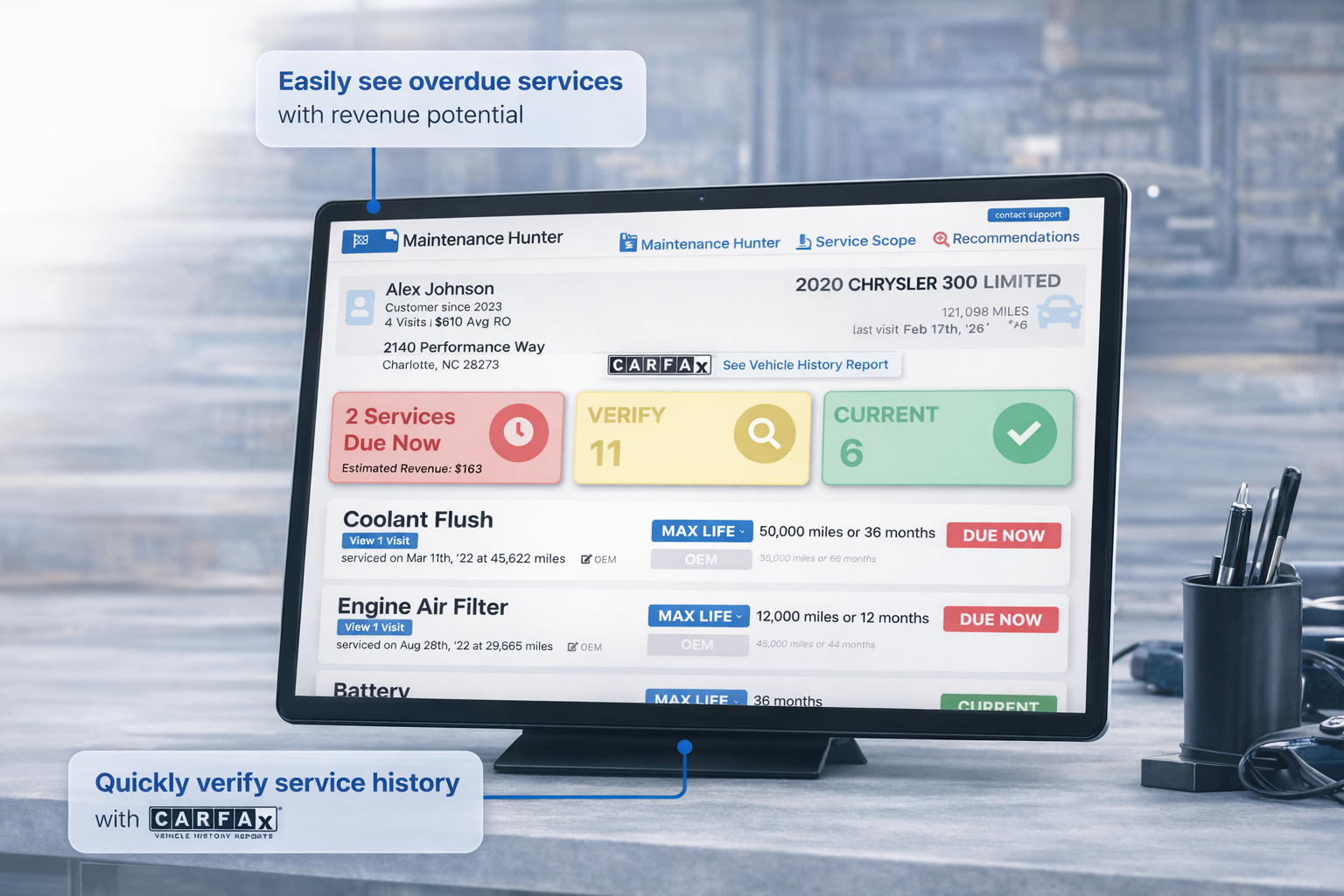
Here's a question every multi-unit owner should be able to answer: which of my service advisors is consistently recommending maintenance to customers, and which one is letting revenue walk out the door? Most operators can't answer this precisely. They have a gut feeling, but they don't have the numbers. And without the numbers, you can't coach — you can only complain.
After 25 years operating multi-unit tire and auto service businesses, I can tell you the gap between your top-performing advisor and your bottom-performing advisor is almost never about personality, training, or natural sales ability. It's about what they can see before writing the estimate. Give every advisor the same visibility, measure them on the same standards, and the performance gap closes faster than you'd believe.
Why Scripts Don't Work (And What Does)
Most service advisor training focuses on personality and scripts. "Build rapport. Ask open-ended questions. Handle objections." Those skills matter, but they're not where most shops are losing money. Shops lose money because advisors don't recommend services that are already due on the vehicle — not because customers say no to recommendations.
Data from thousands of shops running SideKick360 shows that 40–70% of vehicles leave without services that were objectively due per the manufacturer's maintenance schedule. That's not a selling problem. That's a visibility problem. Your advisors don't fail to sell a brake flush; they fail to know it's due.
The Advisor KPIs That Actually Matter for Coaching
If you're going to coach advisors on maintenance sales, you need data at the advisor level — not just the shop level. Here are the metrics that actually drive coaching conversations:
1. Revenue per Repair Order (ARO) by Advisor
The headline number. If Advisor A is at $620 ARO and Advisor B is at $380, there's $240 per ticket on the line. Across 30 tickets a week, that's $7,200 per advisor per week. Over a year, that's real money. But ARO alone doesn't tell you why — you need the next three metrics to diagnose.
2. Maintenance Capture Rate by Advisor
For every vehicle that was due for service X, did this advisor recommend it? This is the single most diagnostic metric. If your top advisor's maintenance capture rate is 80% and your bottom advisor is at 25%, you know exactly where to focus the coaching. It's not about selling harder — it's about consistently recommending what's due.
3. Inspection-to-Sale Conversion
Of the services an advisor recommends, how many does the customer approve? This separates the coaching conversation into two parts: Are you recommending enough (capture rate), and are you communicating value when you do (conversion rate)? Advisors often need different coaching depending on which metric is weak.
4. Services Per Repair Order
Two advisors can hit the same ARO very differently. One might run a lot of single-line brake jobs at $800 each. Another might build tickets with an oil change, tire rotation, cabin filter, engine filter, and alignment for $450. The second advisor is building loyal customers who come back; the first is transactional. Services per RO tells you which pattern each advisor is running.
5. Customer Retention by Advisor
Do this advisor's customers come back? Retention is a 6-month trailing metric, so it's slower to act on — but it's the ultimate judge of whether advisors are building the business or just running transactions. An advisor with high ARO but low retention is a short-term win and a long-term problem.
The Coaching Conversation That Changes Behavior
Here's what separates effective advisor coaching from lectures: specificity. Vague coaching ("you need to sell more maintenance") produces vague behavior change. Specific, data-backed coaching produces actual change.
Compare these two conversations:
- Vague (ineffective): "Your numbers are down this month. You need to sell more services."
- Specific (effective): "Yesterday you had 14 vehicles come through. 11 of them had maintenance overdue per the manufacturer's schedule — an average of 2.3 services per vehicle past due. You recommended services on 4. Let's look at the 7 you missed and figure out why."
The second conversation is coachable. The advisor can answer it. They might say "I didn't know it was due" (visibility problem — fix the tools), or "I knew but didn't bring it up" (confidence problem — role-play), or "the customer was in a hurry" (process problem — change the write-up flow). Each answer points to a different fix. Vague coaching can't get you there.
The Tool Stack for Data-Driven Advisor Coaching
Most shop management systems (NAPA TRACS, Tekmetric, Mitchell 1, FreedomSoft TireShop, ASA TireMaster, R.O. Writer) capture repair order data but don't surface advisor-level coaching metrics. That's where an analytics layer comes in.
SideKick360 connects to your existing SMS and builds advisor-level scorecards automatically. For every advisor at every location, you see ARO, maintenance capture rate, inspection conversion, services per RO, and customer retention — side by side, ranked, with trend lines. That's the data that turns a vague "be better" into specific, coachable action.
Multi-unit operators running SideKick360 consistently see this pattern: within 90 days of daily advisor scorecards, the bottom 30% of advisors close half the gap to the top 30%. Not because they became better salespeople. Because they finally saw what they were missing — and their managers finally had something specific to coach on.
Frequently Asked Questions
What KPIs should I track for service advisors?
The five that matter most for coaching: (1) Revenue per Repair Order (ARO), (2) Maintenance Capture Rate, (3) Inspection-to-Sale Conversion, (4) Services per Repair Order, and (5) Customer Retention. Track them weekly at the advisor level, compare across advisors and stores, and use the gap between top and bottom performers as your coaching roadmap.
How do I train service advisors to sell more?
Shift focus from scripts and personality to visibility and accountability. Make sure every advisor sees what's due on every vehicle before the estimate is written (Maintenance Hunter or equivalent), then coach on the specific vehicles where recommendations were missed. Specific, data-backed coaching changes behavior faster than general sales training.
Should service advisor compensation be tied to maintenance sales?
Most high-performing shops use a combination of salary plus commission on labor and gross profit. Tying comp explicitly to "maintenance sales" can incentivize pushing unnecessary services, which damages retention. A better approach: compensate on overall GP and ARO, and use maintenance capture rate as a coaching metric, not a compensation driver. Let the data show which advisors are consistently capturing what's due, and coach (or replace) the ones who aren't.
How long does it take to see results from advisor coaching?
Measurable improvement shows up in 30–60 days if the coaching is specific and data-backed. Shops implementing daily advisor scorecards typically see their bottom-tier advisors improve by 15–25% in ARO within 90 days. Without specific coaching data, general sales training rarely produces sustained change.
Ready to See Your Advisor Scorecards?
Book a free 30-minute demo and we'll show you what advisor-level scorecards look like on your own shop data. No scripts, no sales training pitch — just the numbers that make coaching conversations productive.
Related: How to Increase Average Repair Order • Meineke Garner Group Case Study • Multi-Location Auto Repair Software

