
If you only tracked one KPI in your auto repair shop, it would be average repair order (ARO). Car count is largely a function of location and marketing — it's slow to move and expensive to change. ARO is different. ARO is within your control every single day, and it compounds across every ticket, every advisor, every store.
Every $50 you add to your average repair order, across 1,000 tickets a month, is $50,000 in monthly revenue. Across 20 locations, that's $12 million a year — from a single KPI moving in the right direction. This is why multi-unit operators obsess over ARO. And it's why, when we look at data from thousands of shops running SideKick360, we've learned exactly where the opportunity hides.
Here's the thing most shop owners get wrong about raising ARO: they think it's a selling problem. It's not. It's a visibility problem. Your advisors don't fail to sell maintenance because they're bad at selling — they fail because they don't know it's due. Fix the visibility, and the ARO comes with it.
What Is Average Repair Order, and What's a Good ARO?
Average repair order is exactly what it sounds like: total revenue divided by total number of repair orders for a given period. If your shop did $50,000 in revenue on 200 ROs last week, your ARO was $250. Different shop types see different benchmarks:
- General auto repair: $400–$550 is typical; top performers run $700+
- Tire-focused shops: $300–$450 is common; strong multi-unit tire chains hit $500+
- Import and European specialty: $600–$900 ARO because parts and labor are higher
- Quick lube with service: $150–$250 unless aggressively bundled
But the benchmark that matters most isn't industry average — it's your own shop, two years from now. And the operators who move their ARO meaningfully share one trait: they built visibility into what should have been sold.
A Real-World Example: $264 to $568 ARO in 12 Months
Meineke Garner Group, a single-location Meineke franchise, was running ARO around $264 in early 2025 — a solid number for their market. Monthly sales sat at roughly $53,600. They weren't losing customers. Their advisors weren't lazy. They were missing things.
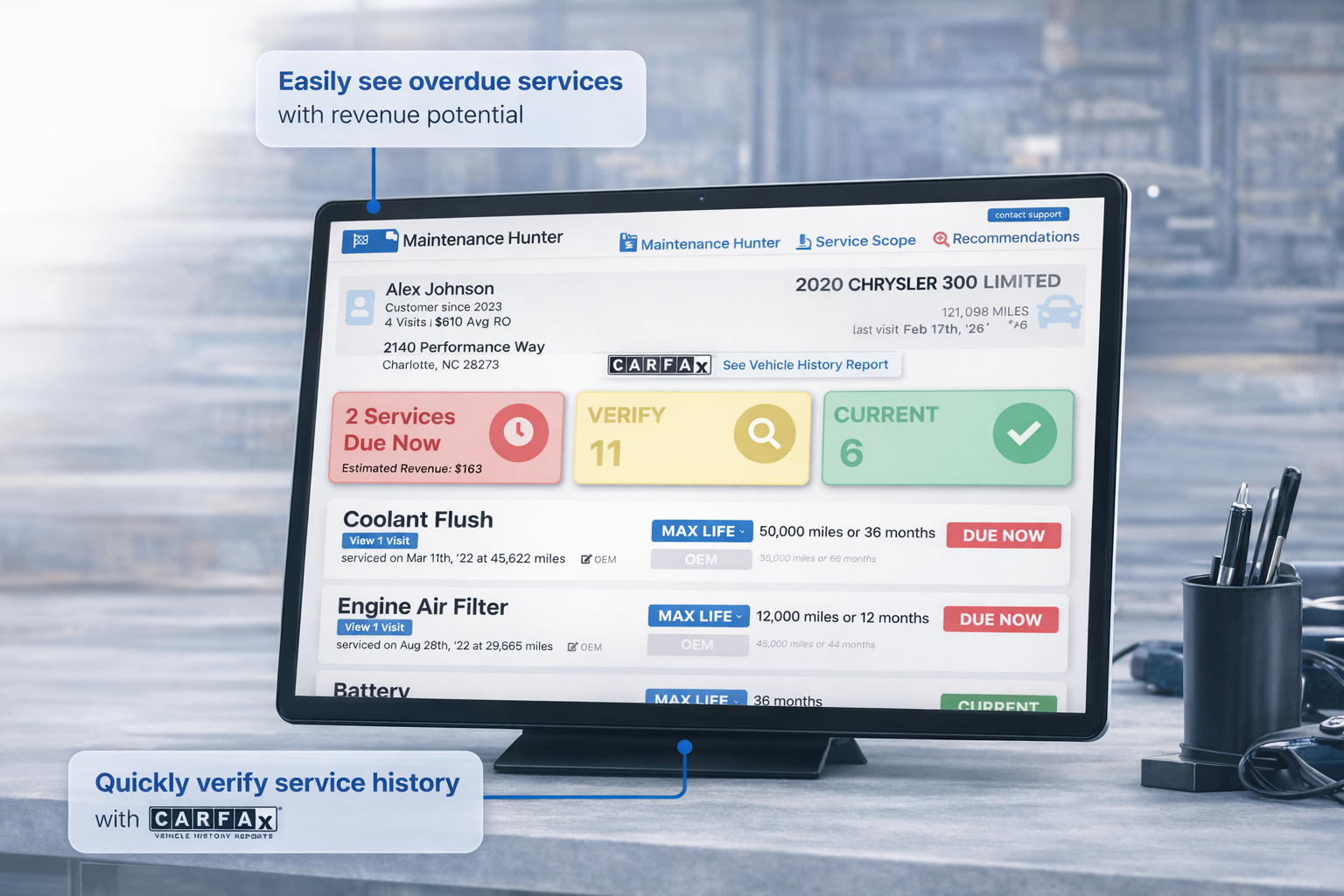
After implementing Maintenance Hunter — which scans every vehicle against OEM maintenance schedules in under 4 seconds — their ARO moved to $568 over the next 12 months. Monthly sales went from $53,600 to $141,500. That's not a pricing change or a new product line. That's the same customer base, same advisors, same shop. The difference was what advisors could see before writing the estimate.
The services that grew most were the ones easiest to miss: coolant flushes (+1,967%), fuel system service (+800%), brake flush (+563%), transmission fluid (+229%), alignments (+165%). These weren't sold harder — they were recommended more consistently because the system surfaced them before the advisor even opened the work order.
5 Ways to Increase ARO (Ranked by Impact)
1. Scan every vehicle against OEM schedules, proactively
This is the single highest-leverage move you can make on ARO. Before the advisor writes the estimate, know what the manufacturer says is due based on mileage and time since last service. Oil changes, coolant flushes, brake fluid, transmission fluid, differential fluid, transfer case fluid, spark plugs, air filters, cabin filters, alignment intervals — every vehicle has a maintenance schedule, and every vehicle is behind on something.
Doing this manually is a fantasy. An advisor handling 15 cars a day cannot accurately compute service intervals from the build date and current mileage for every vehicle. Tools like Maintenance Hunter inside SideKick360 do it automatically in under 4 seconds per vehicle.
2. Track declined services and actually follow up
Most shop management systems (NAPA TRACS, Tekmetric, Mitchell 1, and others) capture declined services at the ticket level. Almost none of them reliably surface them on the next visit. That gap is worth real money. A customer who declined a brake flush three months ago is ready to talk about it now — but only if the advisor knows to bring it up.
Your process needs to make declined-service data visible at the next write-up, automatically. Not buried in a report someone might look at at end of day.
3. Measure advisor-level inspection-to-sale conversion
Two advisors in the same shop can run wildly different ARO numbers. The difference isn't personality — it's that one is consistently recommending maintenance and the other isn't. You can't coach what you can't measure. Track, by advisor, across all locations:
- Revenue per repair order
- Services recommended per vehicle
- Inspection-to-sale conversion rate
- Maintenance capture rate (what was due vs. what was sold)
Post the numbers. Not to shame — to coach. When your lowest-performer sees the top-performer's numbers on the same list, the gap closes quickly. And when a manager can walk up to an advisor and say "you had 14 vehicles yesterday with overdue maintenance and recommended services on 3," that's a coaching conversation that actually moves the needle.
4. Bundle tire services with maintenance services
When a customer comes in for tires, your ARO opportunity is massive — because you already have the car on a lift. Tire rotation, wheel alignment, brake inspection, TPMS service, suspension check, cabin and engine air filters — all of these are easier to sell when the car is already in the shop for tires. Multi-unit tire operators running enterprise analytics consistently see $80–$150 higher ARO on tire tickets that include proactive maintenance recommendations.
5. Give managers daily visibility into ARO by store, advisor, and day
You can't manage what you can't see. If your managers only see ARO at month-end, you're correcting too late. Multi-unit operators who hit their ARO targets are the ones whose managers get a daily text or dashboard showing yesterday's ARO by advisor, with a period-over-period comparison. Same-day visibility creates same-week course correction.
The Tool Stack That Makes This Actually Measurable
You don't need to migrate off your current shop management system to improve ARO. Your SMS is doing its job — writing tickets, managing inventory, handling payments. What you need is an analytics layer that sits on top, normalizes your data, and surfaces the visibility your managers and advisors need.
SideKick360 is an official integration partner with NAPA TRACS, Tekmetric, Mitchell 1, FreedomSoft TireShop, ASA TireMaster, R.O. Writer, TCS TireWorks HD, Hoops & Gears, and Protractor. It adds Maintenance Hunter, advisor benchmarking, and daily ARO visibility on top of whichever system your shops run today — including mixed SMS environments where different locations run different platforms.
One shop that made Maintenance Hunter part of every visit added over $40,000 a month in gross profit within 60 days. The highest performers double their ARO within 12 months. Not because they're selling harder — because they're finally seeing what was always there.
Frequently Asked Questions
What is a good ARO for an auto repair shop?
General auto repair shops typically run $400–$550 ARO, with top-performing shops hitting $700 or more. Tire-focused shops usually see $300–$450, and specialty import/European shops can exceed $900. The best benchmark isn't industry average — it's your own shop's trend over time. Moving ARO up $50 per ticket is almost always more valuable than chasing the top of your industry segment.
How do I calculate ARO?
Divide total revenue by total repair orders for a given period. For example, $80,000 in sales across 200 repair orders last month = $400 ARO. Most shops calculate it monthly, but weekly (and daily at the advisor level) is where the coaching happens.
Why is my ARO low?
The most common reason isn't pricing or bad advisors — it's missed maintenance opportunities. Most shops' data shows that 40–70% of vehicles leave without services that were due per the manufacturer's maintenance schedule. That's revenue that was already "sold" by the OEM but never recommended by the advisor because the system didn't surface it in time.
Will pushing more services hurt customer retention?
No — and this is the biggest myth in auto repair. Customers want to trust their shop. When you recommend manufacturer-backed maintenance with clear justification ("your transmission fluid is due per Toyota's schedule for your mileage"), customers feel cared for, not sold to. The shops with the highest ARO tend to have the best retention, because customers see them as the trusted adviser who catches things. The shops that lose customers are the ones that surprise people with expensive repairs because preventive maintenance was never recommended.
Do I need to change my shop management system to improve ARO?
No. NAPA TRACS, Tekmetric, Mitchell 1, FreedomSoft, and other major shop management systems are excellent at what they do. The opportunity is to add an analytics layer on top that gives you proactive maintenance visibility, advisor benchmarking, and daily ARO tracking — without disrupting your current workflow. That's exactly what SideKick360 does.
Ready to Start Moving ARO?
See what your ARO could look like with Maintenance Hunter running on every vehicle. Book a free 30-minute demo — we'll show you live data from your shop and walk you through what the highest-ARO operators do differently.
Related: How Meineke Garner Group Doubled Revenue • How Steger Service Grew GP $39K • Multi-Unit Enterprise Analytics • Multi-Location Auto Repair Software
