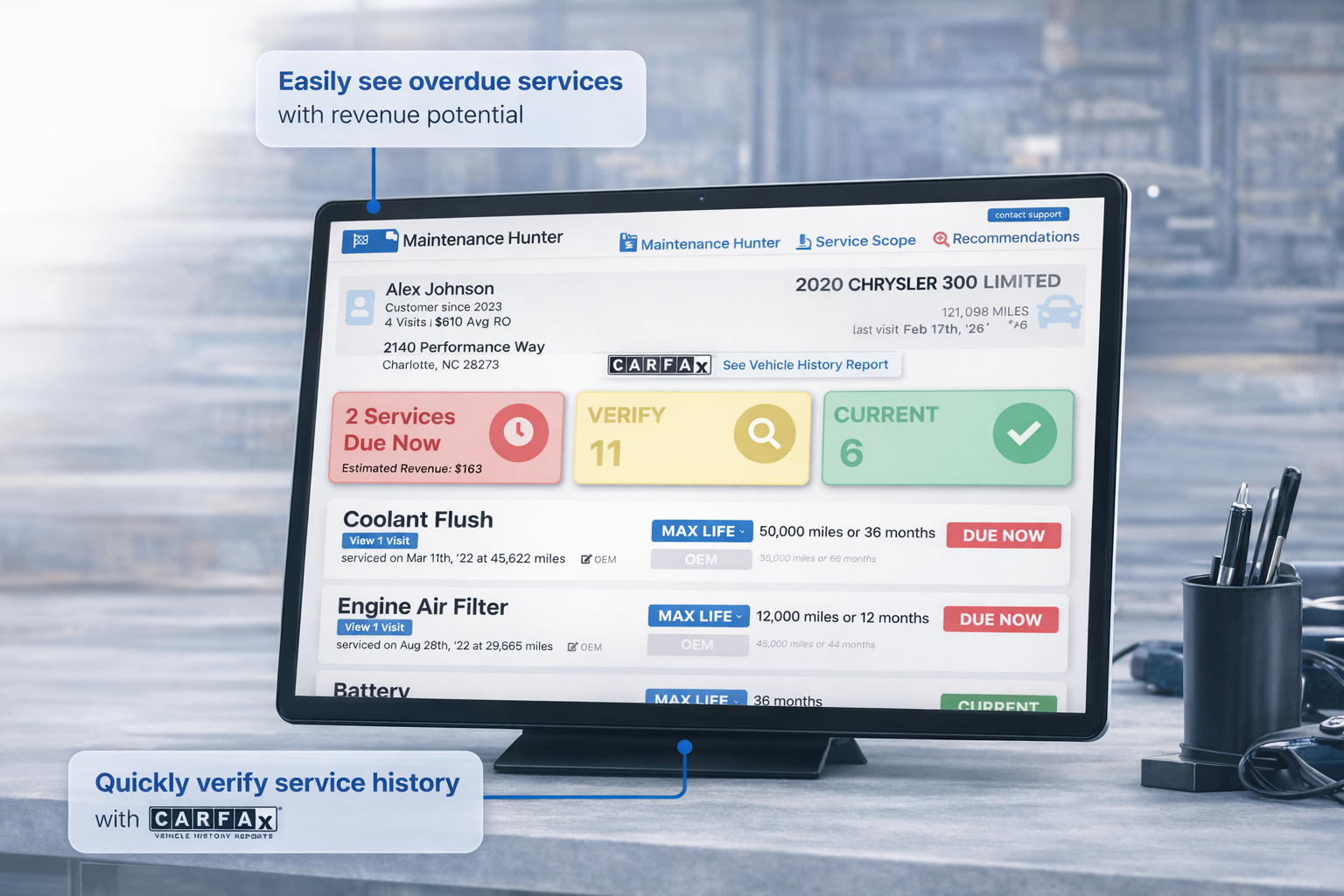

For the last twenty years, software companies competed by building better applications. The company with the best CRM won. The company with the best DVI won. The company with the best scheduler won. The company with the best reporting won.
That world is changing faster than most people realize.
Today, AI can help build software in days that previously took months. Foundation models get more capable every quarter, and the cost of development keeps falling. As software becomes easier to create, one question becomes more important than any other:
What is the AI learning from?
The Real Asset Isn’t the Application
Over the past eight years, we’ve invested in something most people never see. Not another dashboard. Not another mobile app. Not another marketing tool.
We built a standardized operational data engine.
Every day it normalizes millions of data points flowing through independent repair shops, creating a common language across different shop management systems, vendors, and workflows.
That engine understands virtually every stage of the customer journey:
- Appointment scheduling
- Customer communication
- Vehicle check-in
- Digital inspections
- Maintenance evaluations
- Advisor recommendations
- Technician activity
- Parts sourcing
- Vendor purchasing
- Labor operations
- Tire sales
- Service history
- What was sold — and what wasn’t
- Every customer and every vehicle
The software matters. But the standardized operational intelligence underneath it matters even more.
AI Is Only As Good As Its Data
There’s a misconception that AI is becoming the competitive advantage. I don’t believe that’s true.
Everyone will have access to incredible AI. What they won’t all have is AI-ready data — clean, standardized, and organized around how their business actually runs.
AI without context produces generic answers. AI trained on clean, normalized, operational data begins to understand how a business actually works — how an advisor’s recommendation becomes a sold service, how a tire sale leads to an alignment, how a customer’s history predicts what’s due next.
That’s where real intelligence begins.
We’re Seeing Something We Didn’t Expect
One of the most exciting developments isn’t happening inside SideKick360. It’s happening with our customers.
Shop owners are taking their standardized operational data and building things we never imagined:
- AI-powered CRMs
- Customer portals
- Intelligent websites
- Internal copilots
- Operational dashboards
- Executive reporting
- Workflow automation
- AI agents tailored to their business
Five years ago they would have asked us to build those products. Today they’re building many of them themselves.
That’s a remarkable shift.
They’re no longer waiting for software vendors to decide what’s possible. They’re building it themselves.
— Patrick Murphy, Founder & CEO, SideKick360
The Connected Shop Looks Different
For years the industry talked about “integration.” Connect the shop management system. Connect the CRM. Connect marketing. Connect inspections. Connect accounting.
But integration is only the beginning.
The future isn’t about connecting applications. It’s about creating one trusted source of operational intelligence that every application, every workflow, every employee, and every AI agent can understand.
Here’s how I think about the modern shop’s stack — four layers:
| Layer | What Lives There |
|---|---|
| 1. Systems of record | The shop management systems already running the shop — Tekmetric, NAPA TRACS, Mitchell 1, Shop-Ware, and others |
| 2. Data standardization | SideKick360’s engine — one common data model across every system, vendor, and workflow |
| 3. Intelligence | Maintenance Hunter, missed opportunity, performance analytics, customer intelligence, advisor coaching |
| 4. AI applications | CRMs, customer portals, copilots, voice agents, marketing, executive reporting — built by us, and increasingly by our customers |
Layer 2 is the one nobody sees — and it’s where the years went. Think of it as a data operating system for the aftermarket. Every layer above it works because that layer exists.
When every system speaks the same language, innovation accelerates dramatically.
The New Competitive Moat
Twenty years ago, software was the moat. Ten years ago, integrations became the moat. Today I believe something else is happening.
The moat is becoming proprietary, standardized, contextual data combined with deep domain expertise.
Anyone can access an LLM. Very few companies have spent years organizing operational data into something AI can truly understand. That’s a completely different asset.
Anyone can export a CSV file, too. Very few companies can take data from ten different shop management systems and make every invoice, labor line, advisor, service, technician, vendor, tire, inspection, maintenance recommendation, and vehicle history mean exactly the same thing across all of them. That’s years of work. That’s the intellectual property.
And let me be precise about what that asset is, because the distinction matters. It isn’t just data. It’s AI-curated data — every repair order, every recommendation, every service already cleaned, normalized, and organized so AI can actually use it.
Data by itself means nothing. AI-curated data means everything — and for every SideKick360 operator, it’s two clicks away.
It’s also why I’ve stopped thinking of SideKick360 as just a software company. What we’re really building is the operational data platform for the automotive aftermarket — the trusted foundation that shops, vendors, applications, and AI agents can all build on. That’s a much larger vision than any single product, and I think it’s the story the market is just beginning to understand.
Looking Ahead
The next decade won’t belong to the companies with the most software. It will belong to the companies with the best AI-curated data.
The companies that understand not only what happened — but why it happened, what should happen next, and how to help their customers make better decisions.
And I’d take it one step further. The next decade won’t be about features at all. Nobody ever grew a shop because their software had more tabs. The future is about results — about realizing the potential that’s already sitting in your bays, your team, and your data.
Features are how vendors compete. Results are how shops win.
That’s where AI delivers its greatest value. Not replacing people. Helping them see what they couldn’t see before.
AI is only as good as the operational context behind it. Our greatest asset was never another dashboard — it’s the standardized data foundation that lets every future AI application understand how a repair shop actually operates.
If you want to see what standardized operational data looks like in your own shop — what’s due, what’s being offered, and what’s walking out the door — book a demo and we’ll show you with your own numbers.